A Sweeping Positivity-Preserving Implicit Continuous Galerkin Framework

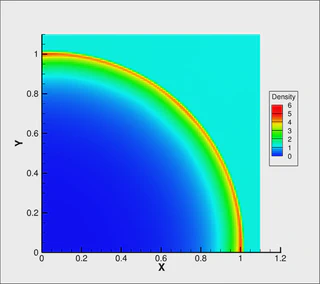 P1 Implicit Continuous FEM Simulation of 2D Sedov Blast with Sweeping Limiter
Introduction
Positivity violations of density and pressure (and internal energy) in the Euler equations lead to ill-posedness, non-physical distortions, and numerical blow-ups. This is particularly due to imaginary sound speed computation which breaks hyperbolicity of the system. Density and pressure positivity are also relevant to Navier-Stokes and magnetohydrodynamics systems. Other physical quantities, including water height in shallow water equations, mass/volume fraction in multiphase flows, and the probability density function in Vlasov-Boltzmann transport equations, also have strict positivity requirements, leading to the need of robust and flexible positivity-preserving methods.
Many numerical methods for hyperbolic conservation laws are not inherently bound-preserving. Even popular high-order and robust methods such as the finite volume (FV) and finite difference (FD) essentially non-oscillatory (ENO) schemes, weighted ENO (WENO) schemes, and discontinuous Galerkin (DG) methods are not inherently positivity preserving. For continuous Galerkin methods, the classical scheme requires stabilization for advection-dominated problems, e.g., the streamlined-upwind Petrov Galerkin (SUPG) formulation. Even with stabilization, the method exhibits oscillations around shocks and discontinuities, requiring additional positivity treatment.
Implicit Time-Stepping and the Sweeping Limiter
Implicit time-stepping procedures are of interest due to their computational efficiency over explicit time-steppers in situations where the CFL condition limits to very small time-step sizes or where complicated geometric restraints lead to time-step restrictions. While the computational cost of a single iteration of an implicit time-stepping procedure is more expensive than an explicit one, the total reduction in the number of time-steps often yields a more efficient scheme.
Existing positivity preserving limiters for continuous finite elements—such as FEM-FCT, AFC, or monolithic flux limiting—are not easily extended to fully implicit schemes due to non-differentiable updates to the residual and restrictive conditions on the time-step. In this paper, we apply positivity treatment as a post-processing step, extending our sweeping procedure to allow the computation of an analytical Jacobian in the Newton solve.
Extensions and Multigrid Acceleration
We extend this simple sweeping procedure to a continuous Galerkin setting as a modular post-processing procedure incorporated in an implicit setting. To determine appropriate weights that maintain conservation while allowing nodal positivity adjustments, we consider locally conserved quantities which, when summed, recover global conservation. We find that the weights are given as the normalized row sum of the consistent mass matrix, which we show are consistent with exact nodal quadrature rules.
While the original method only needed one or two sweeps to converge for the pressure treatment in the finite difference WENO setting, we find that many iterations are needed in some numerical tests with large violations. Thus, we introduce a multigrid procedure to improve convergence. We provide theoretical guarantees for conservation, monotone improvement, and variance reduction, as well as an accuracy proof for the density treatment in the CG setting.
